






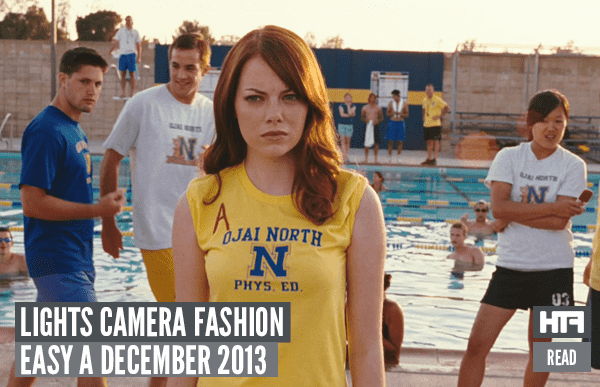
When false rumours begin to circulate about Olive’s promiscuous behaviour – rather than attempting in vain to rectify the gossip – she goes one better and adds fire to flames by creating a style aptly suited to the label she’s been given. Easy A explores the power fashion plays to high school life and the consequences these choices can pose.
Donning a basque top, tight clothing and a suggestive addition of a lollipop, Olive’s subtle changes to huge effect highlight the extent to which she is out of her normal comfort zone/style. An example of a student who could easily settle into any clique without much alteration, Olive could be labelled an example of ‘an outsider’.

Comfortable in herself and easygoing, Olive’s clothing displays her awareness for style but her disregard for fashion. Preferring a casual look composing of jeans, fitted tops and pretty accessories with her hair styled loosely, Olive clearly cares about maintaining a smart appearance.
Perhaps in an attempt to disguise from stereotypes, Olive’s affinity for darker clothes – notably navy blue and black – establishes her as a neutral figure in the school’s surroundings and less cause for gossip – or so she’d hoped.

Olive’s rival and queen bee to the popular group, Marianne is the instigator to the gossip and harbours a disgust for Olive’s promiscuity. Marianne’s strong religious beliefs show clearly through her clothing style. Wearing a panelled school skirt and a shirt tucked under her black top, Marianne’s outfit is uniformed and reserved. With the white collar tucked neatly to show her silver cross, the resemblance to a nun’s attire is strikingly similar.
Marianne’s blonde hair swept back with a headband compliments her virginal style that strikes an opposite in values to Olive’s new fashion.
Keen to make a statement without fully endorsing the slutty trademark, Olive’s self-made basque and personalised ‘A’ sewn to her chest derive from her desire to brand herself with a floozy image. The ‘A’ derives from Nigel Hawthorne’s novel, ‘The Scarlett Letter’ and Marianne’s observation that Olive should “embroider a red A on your wardrobe.” to denote adulterer, to which she vengefully obliges.
Keeping colour to a minimum and the use of sunglasses both as a fashion statement and a disguise, Olive’s desire to make an important statement becomes clear when she reveals the reason for her makeover.